Welcome to our project blog. We will be posting regularly about the six Florida prairies we will be painting through June 2012. Each artist will have stories and images to share as we explore these essential and fragile ecosystems. Stay tuned for scheduled events.
Showing posts with label north Florida prairies. Show all posts
Monday, December 19, 2011
Happy Holidays from the Six Artists Six Prairies Project!
It's the time of year when so many of us are preoccupied with preparations for those special days we share with family and friends. The past couple of years I've taken time out to walk in the prairies with those close to my heart. We enjoy the quiet togetherness, sharing thoughts or none, exclaiming when a bird suddenly jumps out of the bushes and smiling at their calls and song. This year the prairies seem particularly beautiful and the Sandhill Cranes are still flying overhead, calling as they circle. It's a great time to be in nature, appreciating that we still have these pristine places to enjoy in peace. We are so grateful for our conservation partners! The artists of the Six Artists Six Pairies Project wish each of you the happiest of holidays and the joy of wonder and wander!
Mary Jane Volkmann for SASP
Tuesday, September 27, 2011
On a prairie tour with Hutch
This morning we went to Prairie Creek Lodge to meet with “Hutch” (Robert Hutchinson), the Executive Director of the Alachua Conservation Trust. He took us on a tour of the properties surrounding Prairie Creek lodge, along the way explaining the ecology, the response of the land to hydrology as well as their monitoring and observations about the recovery of the land from its past use for grazing. Hutch showed us different wildflowers and berries, osprey and eagles' nests and so generously answered our many questions! Driving through thick and tall bushes, we followed along and then crossed over Prairie Creek, learning about cypress trees and the distinct signs of prairie rims. We walked along the creek for a ways looking at the amazing array of cypress knees. At one point we came upon a little pool of water in which Hutch pointed out a rather large gator just under the surface.... We learned many interesting things about the different types of prairie habitats and plants. We also saw the Green burial cemetery, which is in a beautiful and peaceful setting. The headstones have been so tastefully fashioned from tree trunks, cypress knees, and other natural materials. We are looking forward to observing and painting this beautiful land in different seasons. We came away with such an appreciation of the work being done by the Alachua Conservation Trust to purchase and preserve tracts of land for future generations. We hope that our prairie project will help spread the word about the importance of supporting our conservation partners. Thanks again, Hutch!
Mary Jane Volkmann and Linda Blondheim
Saturday, August 6, 2011
Face to Face with a Green Anole in Paynes Prairie
Anyone who sees me get out of my car with all the gear I take with me to paint might chuckle because I like to anticipate all the things I might need while I'm out there. I've pared it down quite a bit over the years, but I always have certain essentials with me such as my camera, my binoculars and my Audubon Field Guide. These days my smartphone serves as a camera and has field guides! While I paint I sometimes see something I will down my painting tools to photograph. One day in Paynes Prairie I observed this little lizard. I didn't see her at first because she was lying straight in the middle of one of the palm fronds, green as could be. We eyed each other for awhile, then she slowly turned to the side and cautiously started stepping across the fronds, changing colors as she moved. I read that she is a Green Anole (Anolis carolinensis), a member of the Iguanid family. The Smithsonian's National Zoological Park online guide gives some fascinating facts: "Green anoles have adhesive lamellae on their foot-pads for crawling along walls, much like geckos. Able to change color, the green anole can be anywhere from bright green to browns and grays. One thought is that the green coloration is related to dominance. Their color varies depending on their mood, temperature, humidity and health. They are often referred to as the American chameleon, although they are unrelated to chameleons. ...Males are distinguishable from females because males have a pink dewlap, a flap of skin that hangs in an arc below their neck. This dewlap is used for attracting females and in territorial displays...Green anoles have a stereotyped set of behaviors. Male anoles perform rituals of dominance and territoriality. They show their dominance by bobbing their heads, usually through pushup-like movements. They also flare their dewlap. When threatened by another male, the opponents begin with head bobbing and flaring. Then they extend their throat (different than dewlap) to enlarge their body profile, they turn lateral to their opponent, showing the side profile of their body. They also erect crests along the back, and form an eyespot. These performances are intended to intimidate the other anole. The loser of the confrontation performs submissive head bobbing and retreats to a different territory." Oh, and they eat spiders, too. I wish she'd stay next to me and feast on the insects that like to feast on me....
Mary Jane Volkmann
Mary Jane Volkmann
Sunday, June 26, 2011
Clearing the mind and sharpening the senses...
Painting in nature gives me the quietude I need to clear the clutter from my head so I can immerse myself in the incredible world around me, appreciating the fascinating diversity of flora, fauna, colors and design. As I settle in, I become aware of the smell of the grass and the pine needles baking in the sand. My ears start tuning in to the music of nature: the call of the birds, the rustle of a critter in the bushes, the cicadas and grunts of alligators. As I focus in on the subject I am painting I become keenly aware of changes around me. I keep a camera handy to record the unexpected and the beautiful. I remember a precious moment of one hot day in particular. I had my easel up against a bush to try and catch a bit of the shade when suddenly a little bird landed on a twig which was caught on the top corner of my easel. Knowing the bird would never stand still for me to reach for my camera, I caught my breath and held my brush in mid-air so I could memorize the moment. I identified it later as a blue-gray gnatcatcher, a bird I had never seen before! Obviously it flew away, so I cannot share a picture with you, but here is another one I took in Paynes Prairie. Is this bird enjoying life, or what!?!
Mary Jane Volkmann
Mary Jane Volkmann
Saturday, June 25, 2011
Prairie Wetlands
This morning I enjoyed working on this little painting from a reference photo. Each Saturday I paint out in front of my gallery. Today was a special treat because musician Linda Pottberg joined me to entertain visitors to Paddiwhack Gallery in Gainesville, Florida. While I painted the prairie wetlands, she sang folk songs about old Florida and times past. It was a delight and I hope she will join me often. We are lucky to live in north Florida where culture, music and art are readily available.
Linda Blondheim
Linda Blondheim
Thursday, June 23, 2011
Prairie Dusk
Sunsets fascinate everyone, including artists. The prairie provides a nice subject to do a panoramic format sunset painting. Sometimes we are afforded the opportunity to do sunsets on location. The secret is to set up your easel a couple of hours early and block in the basic painting. Then when the beautiful color comes, you are ready to put it in very fast. You only have about fifteen minutes to finish the painting with that glorious light.
Linda Blondheim
Tuesday, June 21, 2011
Observing in the prairies
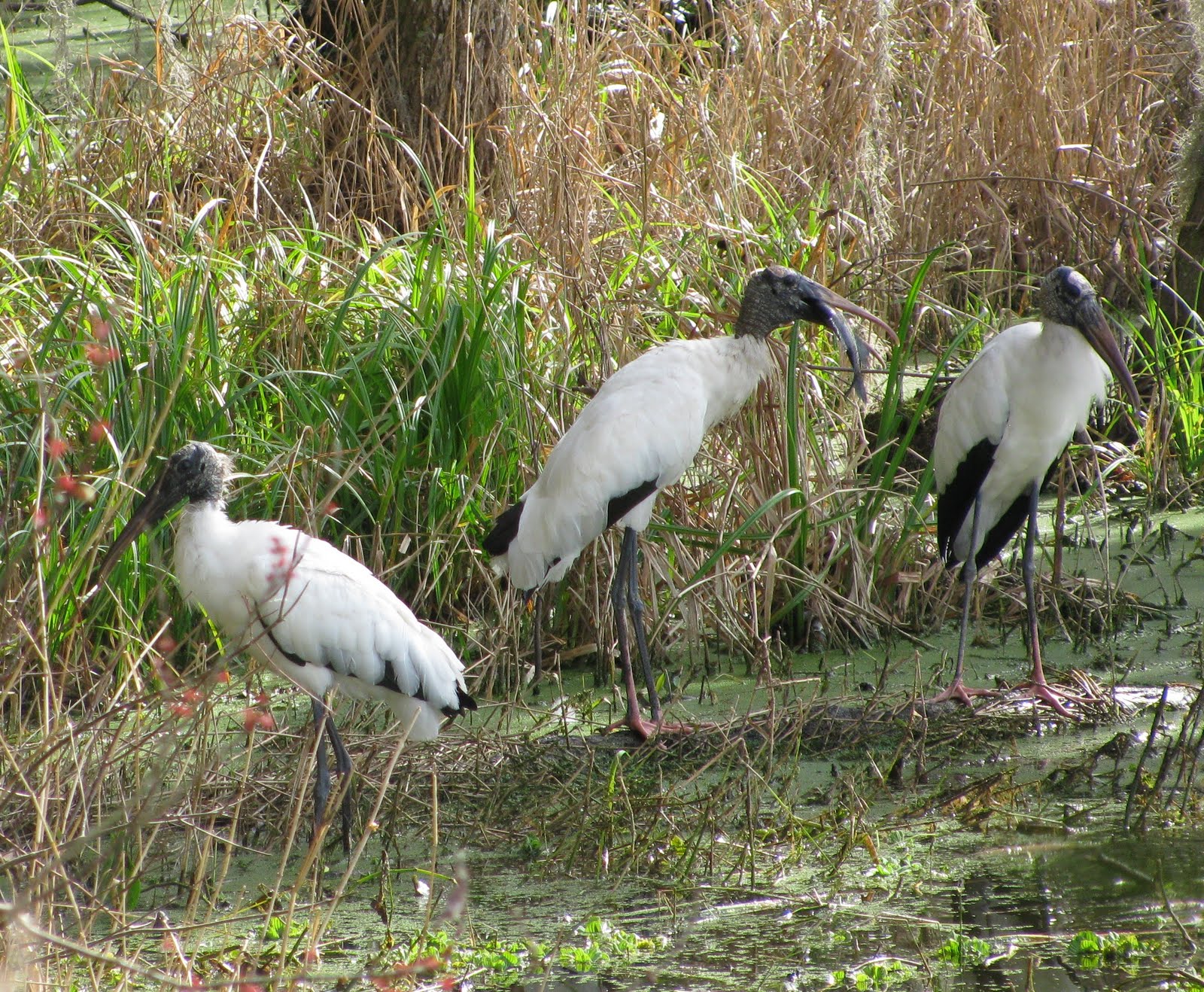
Today I was looking back at the pictures I have taken during my walks and painting sessions in Paynes Prairie over the years and changing seasons, remembering how much I have seen and observed, often just by standing still and looking. I came across this lucky shot. Note the guy in the middle with the fish in his mouth! Well, I assume it's a guy... can anyone enlighten me? Ah, so much still to learn!
Mary Jane Volkmann
Mary Jane Volkmann
Thursday, June 16, 2011
Prairie Weeds
My friend Kay lives on the rim of Tuscawilla Prairie. Lucky me, she sends me reference photos of the prairie at various times when the seasons change. I love this view with the colorful weeds and lily pads sprouting up everywhere. Whenever I travel by this prairie, I see the black and white Oreo cows grazing, adding to my delightful view.
Linda Blondheim
Linda Blondheim
Tuesday, June 14, 2011
Edge of Tuscawilla Prairie
I've been going through the prairie paintings I've done since living in Gainesville. They bring back so many memories of discovery. One morning before the sun had completely emerged from behind the clouds a friend and I went to paint along the roadside at the edge of Tuscawilla Prairie. The subtle colors and swaying small pines above the palmettos drew my attention, so I quickly painted this impression of the scene.
Mary Jane Volkmann
Mary Jane Volkmann
Monday, June 6, 2011
Welcome to North Florida Land Trust our Conservation Partner
We are honored to partner with North Florida Land Trust.
The North Florida Land Trust conserves scenic, natural, agricultural and open land for the future of Northeast Florida in seven counties by:
Our protected lands are located throughout northeast Florida. From historic meadows and tidal wetlands to leafy woodlands and inland wetlands, we are stewards of all North Florida's representative habitats. Some of these properties are small or need prior permission from our Executive Director to access them. We rely on visitors and neighbors to be our eyes and ears on Land Trust properties as well as to report bird and wildlife sightings. We want you to care for our properties as much as we do.
Thousands of acres of land and natural habitat in North Florida are being lost every year to development. Only through conservation efforts at every level will we have success in retaining this area's natural beauty: clean water and air; a healthy ecosystem; and our quality of life.
NFLT relies on support from community members with a strong land conservation ethic to provide financial support that makes our work possible. NFLT is a regional land trust that spans seven counties: Baker, Clay, Duval, Flagler, Nassau, Putnam and St. Johns counties.
The North Florida Land Trust is a local, non-governmental, non-profit organization funded largely by membership contributions. The Land Trust works closely with private landowners and other public agencies at all levels of government, nonprofit partners, and foundations. The North Florida Land Trust is a member of the Florida Alliance of Land Trusts and subscribes to the Standards and Practices of the national Land Trust Alliance.
I am delighted to partner with North Florida Land Trust for our Six Artists Six Prairies project.
Scott Hiestand
The North Florida Land Trust conserves scenic, natural, agricultural and open land for the future of Northeast Florida in seven counties by:
- Developing long term land protection strategies
- Promoting private and public funding for land conservation
- Acquiring land and conservation easements
- Stewardship including the restoration of conservation properties
- Promoting a sense of place and a land ethic through activities, education and outreach.
Our protected lands are located throughout northeast Florida. From historic meadows and tidal wetlands to leafy woodlands and inland wetlands, we are stewards of all North Florida's representative habitats. Some of these properties are small or need prior permission from our Executive Director to access them. We rely on visitors and neighbors to be our eyes and ears on Land Trust properties as well as to report bird and wildlife sightings. We want you to care for our properties as much as we do.
Thousands of acres of land and natural habitat in North Florida are being lost every year to development. Only through conservation efforts at every level will we have success in retaining this area's natural beauty: clean water and air; a healthy ecosystem; and our quality of life.
NFLT relies on support from community members with a strong land conservation ethic to provide financial support that makes our work possible. NFLT is a regional land trust that spans seven counties: Baker, Clay, Duval, Flagler, Nassau, Putnam and St. Johns counties.
Our Mission
The Mission of the North Florida Land Trust is to preserve and protect open space in Northeast Florida. Preservation of open space benefits our community by adding to quality of life values for the residents of our community, preserving precious natural habitats and the rural character of Northeast Florida for future generations.History
Founded in 1999, The North Florida Land Trust has over eleven years experience conserving and protecting lands in North Florida. In all, 130 acres are owned by the North Florida land Trust and over 500 acres are protected by conservation easements. North Florida Land Trust has protected more than 1,100 acres of beautiful, productive and environmentally significant land in and around Northeast Florida.The North Florida Land Trust is a local, non-governmental, non-profit organization funded largely by membership contributions. The Land Trust works closely with private landowners and other public agencies at all levels of government, nonprofit partners, and foundations. The North Florida Land Trust is a member of the Florida Alliance of Land Trusts and subscribes to the Standards and Practices of the national Land Trust Alliance.
Best Standards and Practices
Through the adoption of and adherence to the Land Trust Alliance's Best Standards and Practices, our organization has reached a high level of professionalism. This is essential for the responsible operation of a Land Trust and ensures that a land trust operates legally, ethically and in the public interest. It also establishes a sound program of land transactions and stewardship.Governance
The North Florida Land Trust is governed by a highly involved Board of Directors and is enthusiastically supported by over 500 members. The day-to day operations of the Land Trust are overseen by Bonnie Barnes, our Executive Director.I am delighted to partner with North Florida Land Trust for our Six Artists Six Prairies project.
Scott Hiestand
Sunday, May 29, 2011
Recon at Fish Prairie
Notes From Fish Prairie
Today I visited Fish Prairie via the Sebastian Solski Trail at Fair Oaks. I enjoyed a leisurely exploration of the prairie and the trail this morning. The prairie is full of small trees and grasses so getting a glimpse is not easy in the summer. I imagine it will be a bit easier in the winter when much of the foliage will be gone. I still enjoyed the trail and got many reference photos for paintings. I disturbed a lovely doe who leaped away into the woods adjacent to the prairie. This prairie, unlike Paynes is secretive and mysterious. It appeals to me for its natural Florida scenery. It is a hideaway bordering private land. I believe I am going to enjoy painting this prairie. I hope to get there in June again to do some small field paintings.
Linda Blondheim
Tuesday, May 24, 2011
Fish Prairie
Trees along the Solskis Trail-Fish Prairie Study I will be painting Fish Prairie a lot during our project. I'm fond of it because its rim is adjacent to Fair Oaks, my favorite painting location, in Evinston Florida. We will also have access to it from Mr Ben Franklin's land. It is a small prairie and I've not learned much about its history yet but I'm hoping some of the farmers and land owners I know in Micanopy and Evinston will reveal bits of its history to me.
My friend Sebastian Solskis has made the prairie access possible at Fair Oaks and owner Rick Knellinger gives us free access to the prairie. We are grateful for the privilege. As soon as the summer is over, I'll be painting there regularly, allowing it to reveal its magic little by little. The trail along the prairie rim is deep and primal in character, a glimpse of Florida as it once was.
Linda Blondheim
Labels:
art,
Florida,
nature,
north Florida prairies,
six artists six prairies
Subscribe to:
Posts (Atom)