Showing posts with label landscape painting. Show all posts

Monday, January 2, 2012

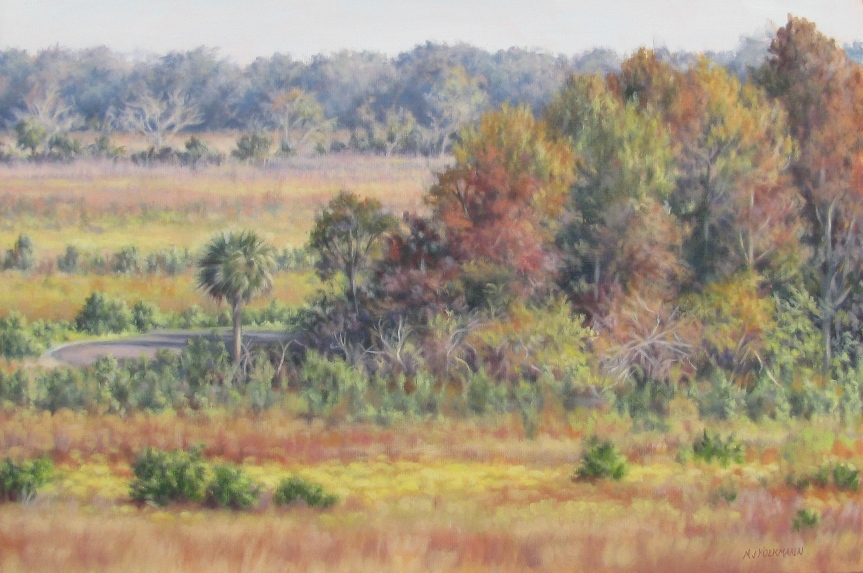
Autumn Dance


It was such a colorful autumn in northern Florida this year.  Was it a combination of dry weather and a seemingly slower changing of the seasons?  I just finished this painting of Paynes Prairie.  I was attracted to the scene because of the colors and design everywhere I looked. As I observed I had the feeling that autumn was dancing in the landscape. 

Over the next couple of weeks I hope to put the finishing touches on several prairie paintings I have in various stages towards completion. I'll post them as they find their resting points. 

Mark your calendars because our big event at Prairie Creek Lodge is drawing near!  On February 25 the Six Artists Six Prairies Project will combine forces with the Alachua Conservation Trust, showing and selling the prairie paintings we have done in an effort to support conservation and artists.  More details will be forthcoming in the coming weeks.

Meanwhile, Happy New Year to everyone!  May this be a special year for each of you!

Mary Jane Volkmann

Monday, August 22, 2011

Paynes Prairie State Park

12x16 inches
acrylic on panel
palette knife

There is an area inside the state park that I really love to paint. It is between the entrance and Puggy Road. It is full of weeds, tall grasses, and palms scattered among the giant oaks. In the fall and winter, the colors turn to blues, rusts, wheats, and olives. That's my favorite painting spot in the park.

Linda Blondheim

Angeline, Thanks so much for writing and I'm glad you like the blog. That was a fun workshops and I'm so glad I was able to be a positive influence for you in painting.
Love,
Linda

Friday, August 19, 2011

Gaining momentum...

This has been an exciting week of making plans with one of our new sponsors and one of our conservation partners.  We are busy finalizing opportunities for the public to meet us, to see and buy our paintings in support of conservation and art, and to get to know our conservation partners, what they do and how we can all support their efforts to preserve our natural world for future generations. 

Early in the week I met with our newest sponsor, Gainesville Wild Birds Unlimited. In case you don't know them, Bubba (that's him in the photo) and Ingrid opened Wild Birds Unlimited in Gainesville a couple of years ago.  It has become a haven for bird and nature lovers seeking everything from creature comforts and food for our birds to guidebooks to natural bugspray ~ a must for those of us who paint outdoors!  Bubba is also the chair of the field trip committee for the Alachua Audubon Society.  They have planned 30 field trips this season! Some of the trips are through the very prairies we are painting.  The schedule will be published this week and can be found at www.flmnh.ufl.edu/aud.


Today I drove out to Prairie Creek Lodge to meet with Hutch and Lesa of Alachua Conservation Trust. It was a beautiful drive under the billowing clouds which kept the temperature manageable and gave me a glimmer of hope that cooler weather is on the way. The lodge itself was a hive of enthusiastic activity punctuated by the ringing of the telephone and the happy smiles of those at work on various projects. Soon the weather will have cooled enough for us to really get out into the prairies to explore and paint on location. Hutch told me that the normally wet prairies are so dry at the moment that in places the cypress knees are totally exposed and so tall. Perhaps it has been the very hot and dry weather, but there seems to be a noticeable absense of the plants which usually give the prairies their unique colors at this time of year. Once we have them finalized, we will share with you news of the plans which Six Artists Six Prairies and the Alachua Conservation Trust are making.


Watch for news about November and February....

Mary Jane Volkmann

Friday, August 12, 2011

Paynes Prairie in the Morning Mist

Early one morning I drove into Paynes Prairie to have a look around to see what had changed in the landscape.  I often do this.  It's part of finding peace, solitude and inspiration.  As I rounded one of the first corners, the sun was rising through a thick veil of mist, casting pearls of light on the dew covered flowering grasses which had sprung up after a fire the year before.  It was so beautiful!  There was design everywhere I looked.  I got out of my car and just stood there, trying to take it all in.  Those of you who know me know my passion for detail and how the intricacies of nature leave me rather breathless with excitement.  Now that it's too hot for me to paint outdoors, I decided to challenge myself to paint this scene in acrylics, working from some photographs I took that day.

Mary Jane Volkmann

Saturday, August 6, 2011

Face to Face with a Green Anole in Paynes Prairie

Anyone who sees me get out of my car with all the gear I take with me to paint might chuckle because I like to anticipate all the things I might need while I'm out there.  I've pared it down quite a bit over the years, but I always have certain essentials with me such as my camera, my binoculars and my Audubon Field Guide.  These days my smartphone serves as a camera and has field guides!  While I paint I sometimes see something I will down my painting tools to photograph.  One day in Paynes Prairie I observed this little lizard.  I didn't see her at first because she was lying straight in the middle of one of the palm fronds, green as could be.  We eyed each other for awhile, then she slowly turned to the side and cautiously started stepping across the fronds, changing colors as she moved.  I read that she is a Green Anole (Anolis carolinensis), a member of the Iguanid family. The Smithsonian's National Zoological Park online guide gives some fascinating facts: "Green anoles have adhesive lamellae on their foot-pads for crawling along walls, much like geckos. Able to change color, the green anole can be anywhere from bright green to browns and grays. One thought is that the green coloration is related to dominance. Their color varies depending on their mood, temperature, humidity and health. They are often referred to as the American chameleon, although they are unrelated to chameleons. ...Males are distinguishable from females because males have a pink dewlap, a flap of skin that hangs in an arc below their neck. This dewlap is used for attracting females and in territorial displays...Green anoles have a stereotyped set of behaviors. Male anoles perform rituals of dominance and territoriality. They show their dominance by bobbing their heads, usually through pushup-like movements. They also flare their dewlap. When threatened by another male, the opponents begin with head bobbing and flaring. Then they extend their throat (different than dewlap) to enlarge their body profile, they turn lateral to their opponent, showing the side profile of their body. They also erect crests along the back, and form an eyespot. These performances are intended to intimidate the other anole. The loser of the confrontation performs submissive head bobbing and retreats to a different territory."  Oh, and they eat spiders, too.  I wish she'd stay next to me and feast on the insects that like to feast on me....

Mary Jane Volkmann
Wednesday, July 6, 2011

Prairie Hyacinths

Prairie Hyacinths


I love these plants. Sometimes they are as thick as a carpet on the prairies here in north Florida. They range in colors from pinkish lavender to blue. I like the blue ones the best. I remember picking them in bouquets and dragging them wet and dripping into my mother's house when I was a kid. They would quickly turn slimy. I'm sure my mother was appalled with that gift but she always acted like she was thrilled to have them.


Saturday, July 2, 2011

After the Storm

After the Storm
Paynes Prairie


This is a palette knife painting. One of the things I am most interested in as a painter is light and atmosphere or what artsy people call aerial perspective. I have studied both of these for many years and continue to. The prairies offer the vistas which make aerial perspective very apparent to the viewer. I find the gradual shift of colors from warm close to me, to cool in the distance, very interesting and beautiful.

Linda Blondheim

Wednesday, June 29, 2011

Choosing a Painting Spot

I have learned to look very carefully before setting up near wet areas to paint.  I've shared this story with some of you before, but one day when I was out painting alone and deep in concentration I noticed out of the corner of my eye that something in the landscape had changed.  I turned to look and saw that one of these guys had crawled out of the brush at the edge of the water and was approaching me to check me out...  I was sitting with all my paints spread around me.  Not having any experience with these things I had to think quickly and remembered that somewhere I had heard that if you make yourself bigger than something it can help.  (Right or wrong?).  So I jumped up and roared as loudly as I could in the deepest voice I could muster, throwing my arms up in the air at the same time in a threatening manner.  True as Bob, the gator flipped and went running away into the water!  I was a bit shaken, so I decided to finish the painting in my studio...

Mary Jane Volkmann

Thursday, June 23, 2011

Prairie Dusk

Sunsets fascinate everyone, including artists. The prairie provides a nice subject to do a panoramic format sunset painting. Sometimes we are afforded the opportunity to do sunsets on location. The secret is to set up your easel a couple of hours early and block in the basic painting. Then when the beautiful color comes, you are ready to put it in very fast. You only have about fifteen minutes to finish the painting with that glorious light.

Linda Blondheim